You don’t have a motivation problem.
You have a discipline problem.
That might sound harsh — but it’s the truth most people avoid.
Motivation feels powerful. It gives you that initial spark. The rush of energy when you decide to start going to the gym, build a business, wake up earlier, or finally take control of your life.
For a few days — maybe even a week — you’re all in.
You show up.
You take action.
You feel unstoppable.
Then something shifts.
You wake up tired.
Work gets busy.
Life gets in the way.
And suddenly, the motivation you were relying on is gone.
This is where most people fall off.
Not because they’re lazy.
Not because they lack potential.
But because they built their progress on something unstable.
Motivation is emotional.
And emotions change.
Discipline, on the other hand, doesn’t care how you feel.
It doesn’t rely on energy, mood, or perfect conditions. It’s built on structure, habits, and identity. It’s the ability to show up when you don’t feel like it. To execute when it’s inconvenient. To keep going when the excitement is gone.
And that’s the difference between people who start… and people who succeed.
In this article, you’ll learn:
- Why motivation is overrated
- How discipline actually works
- How to build a system that keeps you consistent – no matter what’s happening in your life
Because once you master discipline, you no longer need motivation.
This article may contain affiliate links. If you purchase through these links, I may earn a small commission at no additional cost to you.
What Is Motivation (And Why It Fails You)
Motivation is the feeling that makes you want to take action.
It’s the surge of energy after watching an inspiring video.
The excitement of starting something new.
The belief that this time will be different.
And to be fair, motivation isn’t useless.
It’s powerful at the beginning. It helps you start. It gives you that initial push most people need to take the first step.
But here’s the problem:
Motivation is emotional. And emotions are unreliable.
They depend on:
- Your mood
- Your energy levels
- Your environment
- What’s happening in your life
Some days you feel unstoppable. Other days, you don’t even feel like getting out of bed.
If your progress depends on how you feel, your results will always be inconsistent.
The Motivation Trap
Most people fall into the same cycle:
Motivation → Action → Resistance → Drop-off → Repeat
- You feel motivated → you start strong
- You take action → things feel good
- You hit resistance → it gets harder
- Motivation fades → you stop
- You wait to feel motivated again → and restart
This loop can go on for years.
It’s why people:
- Start a diet and quit
- Join gyms and stop going
- Begin projects and never finish them
- Say “I’ll start Monday”… every week
Not because they’re incapable — but because they rely on a temporary state to drive long-term results.
Why Motivation Feels So Convincing
Motivation tricks you into believing:
- “I’ll always feel like this”
- “This time I’ll stay consistent”
- “I just need more motivation”
But motivation doesn’t last.
It’s designed to start actions — not sustain them.
And if you keep depending on it, you’ll always be stuck at the starting line.
The Hard Truth
If you only act when you feel motivated:
- You’ll train inconsistently
- You’ll work inconsistently
- You’ll build your future inconsistently
Inconsistent actions lead to inconsistent results.
That’s why motivation alone will never get you where you want to go.
You don’t need more motivation.
You need something stronger.
👉 And that’s where discipline comes in.
What Is Discipline (And Why It Wins)
Discipline is doing what needs to be done — regardless of how you feel.
No hype.
No waiting for the “right mood.”
No negotiation.
Just action.
While motivation depends on emotion, discipline depends on standards.
It’s the decision you make in advance:
- “I train at 6 am — no matter what.”
- “I write every day — even if it’s just 200 words.”
- “I follow my plan — especially when I don’t feel like it.”
And that’s why discipline wins.
Discipline Is Built — Not Born
A lot of people believe discipline is something you either have or don’t.
That’s wrong.
Discipline is a skill. And like any skill, it’s built through repetition.
You don’t become disciplined overnight.
You become disciplined by keeping promises to yourself — daily.
Even small ones.
- Showing up for a 2-minute plank
- Writing one paragraph
- Going for a short run when you’d rather skip it
Every time you follow through, you reinforce your identity.
The Real Formula for Success
Most people focus on results first.
But the real process looks like this:
Identity → Habits → Results
- You decide who you are
- You act in alignment with that identity
- The results follow naturally
If you see yourself as disciplined, your actions start to match that belief.
You don’t ask:
“Do I feel like doing this?”
You ask:
“Is this what a disciplined person would do?”
Discipline Removes Decision-Making
One of the biggest advantages of discipline is this:
You stop negotiating with yourself.
No more:
- “I’ll do it later”
- “Maybe I’ll skip today”
- “I’ll start tomorrow”
The decision is already made.
And that’s powerful — because most people don’t fail due to lack of ability…
They fail because they keep re-deciding what they should have already committed to.
Discipline Feels Hard — But It Makes Life Easier
At first, discipline feels restrictive.
It feels like effort. Like pressure. Like forcing yourself.
But over time, it becomes automatic.
And instead of making life harder, it actually makes it simpler.
Because:
- You know what needs to be done
- You do it without overthinking
- You build momentum
And momentum is what creates real results.
Motivation might get you started.
But discipline is what keeps you going when motivation disappears.
It’s not about feeling ready.
It’s about being committed.
And once you build discipline, you no longer need to rely on your feelings.
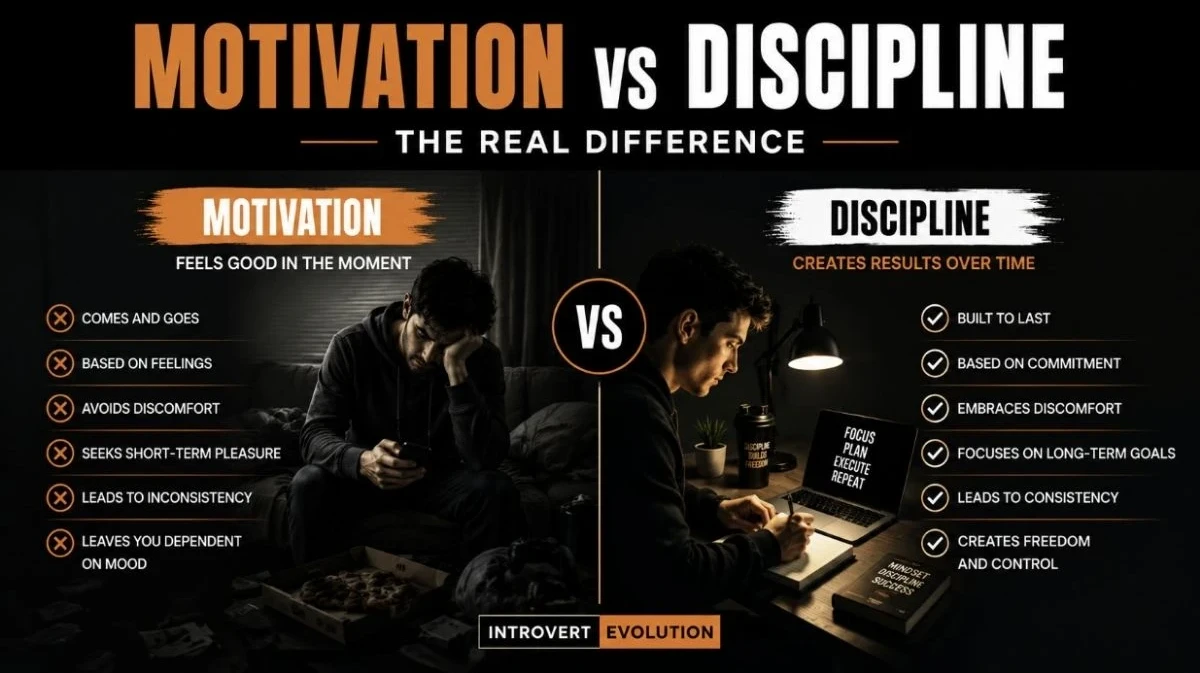
Discipline vs Motivation (The Truth Most People Ignore)
At first glance, motivation and discipline can look similar.
Both can get you to take action.
Both can make you feel productive.
But the way they operate — and the results they produce — are completely different.
The Real Difference
| Motivation | Discipline |
|---|---|
| Driven by emotion | Driven by standards |
| Comes and goes | Stays consistent |
| Requires the “right mood” | Works in any condition |
| Feels exciting at the start | Feels boring — but effective |
| Starts actions | Finishes them |
Why Motivation Feels Better (But Fails)
Motivation is attractive because it feels good.
You feel inspired
You feel confident
You feel like everything is possible
But that’s also its weakness.
Because the moment:
- You’re tired
- You’re stressed
- You’re distracted
That feeling disappears.
And when it does, so does your action.
Why Discipline Feels Hard (But Works)
Discipline doesn’t rely on feelings.
It’s quiet.
Repetitive.
Sometimes even boring.
You:
- Show up when you don’t feel like it
- Stick to the plan when it’s inconvenient
- Do the work even when there’s no reward yet
And that’s exactly why it works.
Because success isn’t built on your best days.
It’s built on the days you don’t feel like showing up — and still do.
The Identity Shift That Changes Everything
Here’s where everything flips:
Motivated people ask:
“Do I feel like doing this today?”
Disciplined people ask:
“Is this what I said I would do?”
That one shift removes hesitation, overthinking, and inconsistency.
It turns action into a standard — not a choice.
The Brutal Truth
If you rely on motivation:
- You’ll only perform when it’s easy
- You’ll stop when it gets uncomfortable
- You’ll stay stuck in cycles
If you build discipline:
- You perform regardless of conditions
- You build momentum
- You get results most people never reach
Motivation is a spark.
Discipline is the engine.
And if you want to succeed long-term — in your fitness, business, trading, or life — you need something that works every day, not just when you feel like it.
How to Build Discipline (Step-by-Step System)
Discipline isn’t something you wait for.
It’s something you build intentionally.
And the mistake most people make?
They try to go from zero to extreme overnight.
They set unrealistic goals, rely on willpower, and burn out within days.
That’s not discipline.
That’s self-sabotage.
If you want discipline that actually sticks, you need a system.
1. Start Small (Non-Negotiables)
Discipline begins with keeping small promises to yourself.
Not big, unrealistic goals.
Small, repeatable actions.
- 2-minute plank
- 10 push-ups
- 5 minutes of writing
- 10-minute walk
These become your non-negotiables.
No matter what happens, you do them.
👉 This is where real discipline starts:
Not in intensity — but in consistency.
2. Remove Decision Fatigue
Every time you think:
“Should I do this now?”
You create an opportunity to skip it.
Disciplined people don’t decide in the moment.
They decide in advance.
- Plan your day the night before
- Set exact times for tasks
- Follow a simple structure
💡 The goal:
Turn actions into automatic behaviours — not daily decisions.
3. Use the Right Tools (Make It Easier to Stay Consistent)
You don’t need motivation — but you do need support systems.
A lot of people try to stay disciplined while surrounded by distractions, a lack of structure, and constant mental clutter.
That makes consistency much harder than it needs to be.
The truth is, disciplined people don’t just rely on willpower.
They create environments that support their habits.
That’s why simple tools can make a big difference.
To stay consistent, remove friction with tools that make your habits easier to follow:
- A structured daily planner to organise your tasks
- A habit tracker to visually track your progress
- A clean workspace that keeps you focused and distraction-free
These tools won’t magically make you disciplined.
But they can make discipline easier to maintain.
Because when your habits are organised, visible, and easy to follow, you spend less time overthinking and more time executing.
One simple tool that can help is the Clever Fox Planner. It’s designed to help you structure your day, prioritise important tasks, and stay focused on long-term goals without feeling overwhelmed.
Even something as simple as planning your day the night before can dramatically improve consistency.
You stop guessing what to do.
You stop wasting mental energy.
And you start building momentum.
4. Build Identity-Based Habits
Discipline becomes powerful when it becomes part of who you are.
Instead of saying:
“I’m trying to be consistent”
You say:
“I am disciplined”
That shift changes everything.
Because now your actions are not optional — they are aligned with your identity.
Ask yourself daily:
“What would a disciplined person do right now?”
Then do that.
5. Eliminate Distractions
You don’t need more willpower.
You need a better environment.
If your phone, notifications, and surroundings constantly pull your attention away from your goals, staying disciplined becomes much harder than it needs to be.
A distracted environment creates distracted habits.
That’s why one of the smartest things you can do is remove as many distractions as possible.
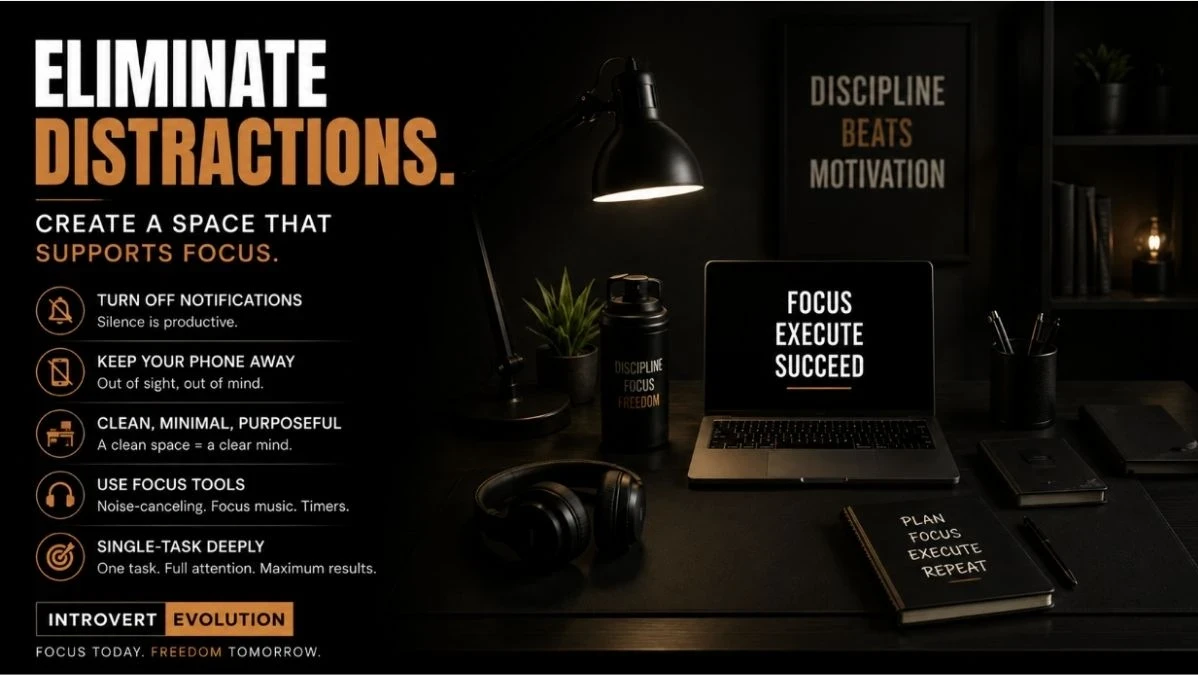
Create a space that supports focus:
- Keep your workspace clean and organised
- Turn off unnecessary notifications
- Put your phone away during focused work sessions
- Make your environment work for you — not against you
The easier it is to focus, the easier it becomes to stay consistent.
Simple tools can also help improve concentration and reduce mental clutter.
For example, noise-cancelling headphones like the Sony WH-1000XM5 can help block out distractions and create a focused work environment — especially during writing, studying, trading, or deep work sessions.
If you spend long hours working on screens, blue light glasses and a clean desk setup can also help reduce fatigue and improve focus over time.
6. Track Your Progress
Discipline grows when you can see your consistency.
Tracking creates awareness — and awareness creates improvement.
A lot of people feel like they’re making no progress simply because they aren’t measuring anything.
But when you start tracking your habits, you begin to notice patterns:
- How consistent are you really
- Where do you usually fall off
- What habits are actually helping you improve
And that awareness changes everything.
Simple things to track:
- Completed habits
- Workouts and runs
- Writing sessions
- Daily routines
- Weekly progress
Even something as simple as ticking a box on a checklist can build momentum.
Because every completed action becomes proof that you’re becoming more disciplined.
One tool that can help is a simple habit tracker or a productivity journal, such as the Legend Planner. It allows you to track habits, goals, routines, and daily progress in one place — making consistency easier to maintain over time.
💡 The key:
“What gets tracked gets improved.”
The more visible your progress becomes, the easier it is to stay motivated, consistent, and disciplined.
7. Embrace Boring Repetition
This is where most people fail.
They want excitement. Variety. Fast results.
But discipline is built through repetition.
Doing the same things:
- Every day
- At the same time
- Without overthinking
It’s not glamorous.
But it works.
Discipline isn’t built through intensity.
It’s built through:
- Small actions
- Clear structure
- Repetition
- Identity
Start small.
Stay consistent.
Remove friction.
And over time, discipline becomes automatic.
The Discipline Mindset Shift
Building discipline isn’t just about habits and systems.
It’s about how you think.
Because if your mindset is still based on feelings, comfort, and convenience, you’ll always find a reason to stop.
Discipline begins the moment you change the way you talk to yourself.
Stop Negotiating With Yourself
Most people lose before they even start.
Not because they can’t do the work, but because they start negotiating.
- “I’ll do it later”
- “I’ll skip today and make up for it tomorrow”
- “I’m too tired today”
Every time you negotiate, you weaken your standards.
Disciplined people don’t negotiate.
They decide once and follow through.
Replace Feelings With Standards
Feelings are inconsistent.
Standards are not.
Instead of asking:
“Do I feel like doing this?”
You ask:
“What is my standard?”
If your standard is:
- Train daily → you train
- Write daily → you write
- Show up → you show up
No debate.
No delay.
That shift alone can completely change your life.
Accept That It Won’t Always Feel Good
This is the part people don’t want to hear.
Discipline is uncomfortable.
You will:
- Feel tired
- Feel unmotivated
- Feel resistance
And that’s normal.
The goal is not to eliminate discomfort.
The goal is to act despite it.
Because growth rarely feels comfortable in the moment.
Become the Type of Person Who Follows Through
Your life changes when your identity changes.
Instead of chasing results, focus on becoming:
- Someone who keeps promises
- Someone who shows up daily
- Someone who finishes what they start
Because once that becomes who you are, discipline is no longer something you try to do.
It becomes something you naturally live.
The Internal Rule That Changes Everything
Adopt this rule:
“If I said I would do it — I do it.”
No exceptions.
No excuses.
That one standard eliminates procrastination, inconsistency, and overthinking.
The Truth About Discipline
You don’t need to feel ready.
You don’t need to feel motivated.
You just need to act.
And the more you act without relying on feelings, the stronger your discipline becomes.
One powerful way to reinforce this mindset daily is with a simple visual reminder of your goals, standards, or routines. Seeing those reminders every day can help you stay focused when motivation disappears.
A simple desk whiteboard or motivational quote board can work surprisingly well for this — especially if you spend long hours working, studying, trading, or building your business.
Daily Discipline Routine (Simple, Repeatable, Effective)
Discipline isn’t built in big moments.
It’s built into your daily routine.
Not something complicated.
Not something overwhelming.
Something simple you can follow every single day — no matter what.
The Goal of This Routine
Not perfection.
Not intensity.
👉 Consistency.
Because consistency is what creates results.
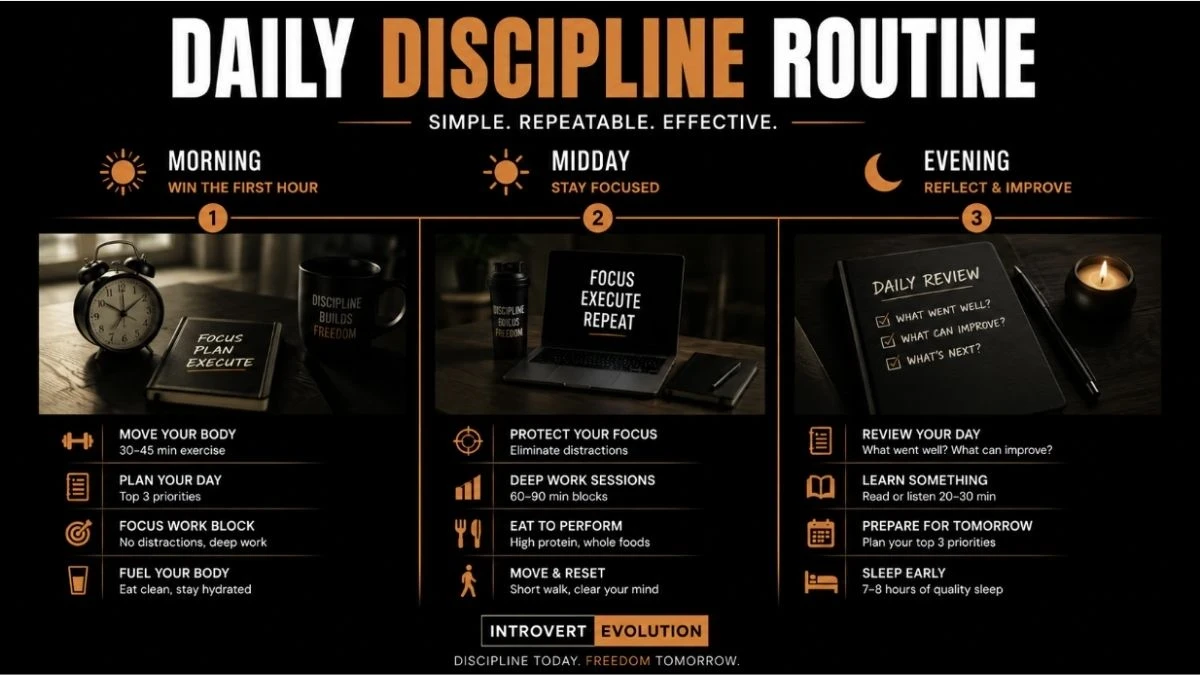
🕒 Morning (Win the First Hour)
How you start your day sets the tone for everything that follows.
Your only goal:
Complete one non-negotiable task.
Examples:
- 5–10 minute workout
- Short run or walk
- Writing a paragraph
- Reviewing your goals
No phone.
No distractions.
Just execution.
💡 This builds momentum early.
To make mornings easier and more structured, tools like a simple daily planner or basic alarm clock can help you stay consistent without relying on willpower.
One great option is the Hatch Restore alarm clock, designed to help create healthier morning and evening routines without immediately reaching for your phone.
🧠 Midday (Focused Execution)
This is where real progress happens.
Set 1–2 focused work blocks:
- 30–90 minutes each
- No distractions
- One task only
Examples:
- Writing your article
- Working on your website
- Trading session
- Skill development
💡 Quality over quantity.
Noise-cancelling headphones, a clean desk setup, and a distraction-free workspace can dramatically improve focus during deep work sessions.
🌙 Evening (Reflection + Reset)
This is where discipline compounds.
Before the day ends:
- Review what you completed
- Tick off your habits
- Plan tomorrow
Ask yourself:
- What did I do well?
- What needs improvement?
💡 This removes decision-making for the next day.
A simple journal or habit tracker can help make reflection and planning part of your routine instead of something you forget to do.
🔁 The Power of Repetition
You don’t need a perfect routine.
You need a repeatable one.
- Same structure
- Same key habits
- Every day
Even on bad days:
👉 You show up
👉 You do the minimum
👉 You keep the streak alive
⚠️ Important Rule
Never miss twice.
If you slip one day — that’s human.
If you skip twice, you’re building a new habit.
A disciplined life isn’t complicated.
It’s structured.
- Simple mornings
- Focused work
- Clear evenings
Do this daily, and over time:
👉 Discipline becomes automatic
👉 Consistency becomes your identity
👉 Results become inevitable
Common Discipline Killers (And How to Eliminate Them)
You don’t lose discipline overnight.
You lose it through small daily habits.
Overthinking.
Skipping once.
Making excuses.
Letting small things slide until they become your default.
If you want to stay consistent, you need to identify what’s killing your discipline — and remove it.
1. Overthinking
You plan too much.
You analyse too much.
You wait for the “perfect moment.”
And while you’re thinking… you’re not acting.
💡 Fix:
- Use the 2-minute rule
- Start immediately
- Focus on action, not perfection
👉 Action creates clarity. Not thinking.
2. Perfectionism
You set unrealistic expectations:
- “I need to do it perfectly”
- “If I can’t do it properly, I won’t do it at all”
So you end up doing… nothing.
💡 Fix:
- Lower the bar
- Focus on completion, not perfection
- Done > perfect
👉 Discipline is built through repetition — not flawless execution.
3. Lack of Structure
If your day has no structure, your actions will depend on your mood.
And mood is unreliable.
💡 Fix:
- Plan your day the night before
- Set fixed times for key habits
- Use a simple routine
👉 Structure removes decision-making.
4. Too Many Goals
Trying to do everything at once:
- Gym
- Business
- Diet
- Content
- Learning
Result?
You burn out.
💡 Fix:
- Focus on 1–3 key habits
- Keep it simple
- Build momentum first
👉 Discipline grows when you win consistently — not when you overload yourself.
5. Environment That Works Against You
Your surroundings shape your behaviour.
If you’re constantly distracted, discipline becomes harder than it needs to be.
That’s why creating a focused environment matters.
Simple changes like:
- A clean desk setup
- Noise-cancelling headphones
- Organised workspace tools
Can dramatically improve concentration and consistency.
For example, a minimalist desk organiser or a pair of noise-cancelling headphones can help reduce mental clutter and make it easier to maintain focused work sessions.
👉 A focused environment makes discipline easier.
6. Relying on Motivation
This is the biggest one.
Waiting until you “feel like it.”
That feeling won’t come consistently.
💡 Fix:
- Follow your schedule, not your mood
- Stick to your non-negotiables
- Act first — feelings follow
7. Breaking Promises to Yourself
Every time you say:
“I’ll do it later”
And don’t…
You weaken your self-trust.
And without self-trust, discipline collapses.
💡 Fix:
- Start small
- Only commit to what you can complete
- Follow through — no matter how small
👉 Discipline = keeping promises to yourself.
Discipline doesn’t disappear.
It gets blocked.
By:
- Overthinking
- Perfectionism
- Lack of structure
- Too many goals
- Poor environment
- Emotional decision-making
Remove these, and discipline becomes much easier.
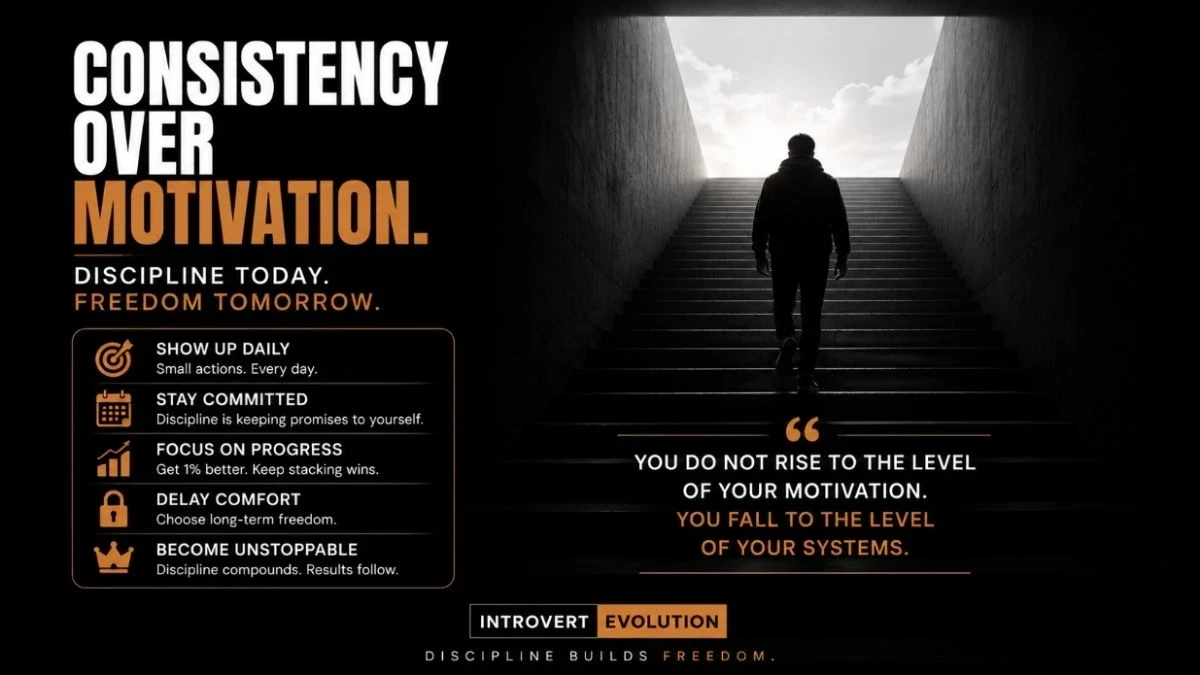
Why Discipline Is Freedom (The Truth Most People Miss)
Most people see discipline as restrictive.
They think it means:
- Less freedom
- More rules
- Less enjoyment
But the reality is the opposite.
Discipline doesn’t take away your freedom.
It creates it.
Discipline Removes Chaos
Without discipline, your life becomes reactive.
- You do things when you feel like it
- You avoid things when they feel hard
- You constantly play catch-up
That leads to:
- Stress
- Anxiety
- Lack of progress
Discipline replaces chaos with structure.
You know what needs to be done.
And you do it.
Discipline Builds Control
When you’re disciplined:
- You control your actions
- You control your time
- You control your direction
You’re no longer:
- Controlled by distractions
- Pulled by emotions
- Stuck in cycles
👉 You take charge of your life.
Discipline Creates Confidence
Confidence doesn’t come from motivation.
It comes from proof.
Every time you:
- Show up
- Follow through
- Do what you said you would do
You build self-trust.
And self-trust leads to confidence.
Discipline Gives You Options
This is where real freedom comes in.
When you’re disciplined:
- You build skills
- You improve your finances
- You stay consistent with your goals
And over time, that creates options.
Options to:
- Change careers
- Work for yourself
- Live where you want
- Design your life
👉 The life you want is built through disciplined actions.
One simple way to stay focused on your long-term goals is to keep them visible daily. A vision board, desk planner, or wall calendar can help reinforce the bigger picture and remind you why consistency matters.
The Hard Truth
An undisciplined life feels easy now…
But becomes hard later.
A disciplined life feels hard now…
But becomes easier later.
You choose when you want to pay the price.
The Shift That Changes Everything
Stop seeing discipline as something that restricts you.
Start seeing it as something that builds your future.
Because every disciplined action you take today is:
👉 Buying your freedom tomorrow.
Motivation gives you a temporary boost.
Discipline gives you a permanent advantage.
It removes chaos, builds control, creates confidence, and opens doors most people never reach.
Start today.
Not when you feel ready.
Not when you feel motivated.
👉 Pick one habit
👉 Make it non-negotiable
👉 Follow through
Because the truth is simple:
You don’t need motivation to succeed.
You need discipline.
By now, you already know the truth:
Motivation is temporary.
Discipline is permanent.
Motivation will come and go.
Discipline stays — and carries you forward even when everything else fades.
The difference between people who succeed and those who stay stuck isn’t talent, luck, or even intelligence.
It’s this:
👉 They do what needs to be done — every single day.
Your Simple Action Plan
Don’t overcomplicate this.
Start small.
Start now.
Step 1: Choose One Non-Negotiable Habit
Pick something simple:
- 5–10 minutes of exercise
- Writing daily
- Planning your day
👉 Something you can do every day — no excuses.
Step 2: Set a Fixed Time
Remove decision-making.
- Morning before work
- Evening before bed
👉 Same time. Every day.
Step 3: Track It
Keep it visible.
- Tick a box
- Use a habit tracker
- Write it down daily
👉 Build momentum through consistency.
One simple tool that can help is a daily productivity planner or habit tracker. Keeping your goals and routines visible makes it much easier to stay consistent over the long term.
Step 4: Follow Through (No Matter What)
You won’t feel like it every day.
That’s the point.
👉 Do it anyway.
You don’t need to feel ready.
You don’t need more motivation.
You need to decide.
Because once you decide:
- You stop negotiating
- You stop waiting
- You start executing
And that’s when everything changes.
One Rule to Live By
“If I said I would do it — I do it.”
No excuses.
No delays.
Just discipline.
If you follow this, even at a small level…
👉 You will become consistent
👉 You will build momentum
👉 You will get results
And over time:
You will become unstoppable.
Related Articles
If you enjoyed this article, you may also find these helpful:
- How To Stay Consistent When Life Gets Overwhelming
- How To Build Self-Discipline When You Have ADHD
- The Power Of A 2-Minute Plank A Day
- 15 Daily Rituals Of Highly Successful Introverts
- The Best Planners For ADHD Introverts (Tested & Ranked)
FAQ
❓ Is discipline really more important than motivation?
Yes.
Motivation helps you start, but discipline is what keeps you going.
Without discipline, you’ll only take action when you feel like it — and that leads to inconsistency.
❓ How long does it take to build discipline?
Discipline isn’t built overnight.
It’s developed through daily repetition.
You can start seeing changes within a few weeks, but real discipline is built over months of consistent action.
👉 The key is not time — it’s consistency.
❓ What is the best way to stay disciplined every day?
Keep it simple:
- Start with one non-negotiable habit
- Set a fixed time
- Track your progress
- Follow through no matter how you feel
👉 Discipline comes from structure — not motivation.
❓ What should I do when I don’t feel like doing anything?
Do the minimum.
- 2-minute version
- Short session
- Small action
👉 The goal is to keep the habit alive — not to perform perfectly.
❓ Can discipline be learned?
Yes — 100%.
Discipline is a skill, not a personality trait.
Anyone can build it by:
- Starting small
- Staying consistent
- Keeping promises to themselves
❓ What tools can help build discipline?
Simple tools can make a big difference:
- Daily planners
- Habit trackers
- Noise-cancelling headphones
- Structured workspace setup
👉 They reduce friction and help you stay consistent.
A simple habit tracker or productivity planner can make it much easier to stay organised and follow through consistently over time.
“The life you want is built one disciplined day at a time.”
Thank you for your time. I hope you found this article helpful. If you have any questions, please comment below or contact me here.
Have a great day!